Here is a number that should not make sense: as of this summer, the median asking price for an active waterfront listing in Guilford is $712,000, spread across 14 homes on the market. The median asking price for the town as a whole, according to Movoto's June 2026 figures, is $879,000. Water is supposed to cost more, not less.
It does cost more. Just not in the way that number implies.
The number that doesn't fit
Ask most buyers what "waterfront premium" means and they picture a bigger price tag attached to a bigger house. In Guilford right now, the opposite pattern is showing up in the active inventory. Waterfront listings are pulling the town median down, not up, because the water lots on the market skew toward small, older homes rather than sprawling new construction. A 1,400-square-foot cottage on Mulberry Point Road recently listed at $1,225,000. A 1,456-square-foot ranch nearby, last sold in 1993, carries a current estimated value in the $550,000s. Neither of those competes on dollar amount with a 4,000-square-foot colonial three streets back from the shore that never touches water.
That is the trick in the median. It measures the sticker price of what happens to be for sale, not the cost of the thing buyers actually want, which is proximity to water. To see that cost, you have to stop looking at the total price and start looking at the price per square foot.
Square footage is the real currency on the water
Guilford's townwide price per square foot sat at $313 in June 2026, according to Movoto, close to the $308 figure PropertyShark reported for Q1 2026 sales. That is the town's baseline. On the water, the math changes completely:
- 698 Mulberry Point Road, a 1,400-square-foot single-family home, recently listed at $1,225,000, or roughly $875 per square foot.
- 76 Sachem Head Road, a 5,620-square-foot estate on 2.31 wooded waterfront acres, listed at $2,799,999, or about $498 per square foot, lower per foot than the smaller cottage because size and land absorb more of the price at that scale.
- 39 Vineyard Place, a 6,603-square-foot home, listed at $5,950,000, or roughly $901 per square foot.
Comparable homes near 474 Mulberry Point Road are listed between $529,000 and $35 million, averaging around $1,200 per square foot across that range. That spread tells you the water lot itself, not the structure sitting on it, is doing most of the pricing work. A buyer comparing two homes with similar bedroom counts can end up paying two or three times as much per square foot for one that happens to sit on Long Island Sound, even when its total price looks comparable to an inland home.
What the Green side of town buys instead
In-town Guilford runs on a different logic. Redfin's most recent neighborhood-level breakdown for Guilford Center, covering October 2025, put the median sale price per square foot at $301, up 23.6% year over year, with a median sale price of $593,000 and homes averaging 59 days on the market. That $301 figure sits close to the townwide average rather than blowing past it, because in-town inventory near the Guilford Green is built on lot size and square footage the way most suburban markets are. You are paying for the house, the historic pedigree, and the walk to the shops and restaurants around the Green, not for direct water access.
That distinction matters for how a dollar performs. A buyer with an $800,000 budget who wants in-town charm can expect somewhere close to full-sized living space. A buyer with the same budget chasing a Sachem's Head or Mulberry Point address should expect a fraction of that square footage, because the price is buying frontage and view, not floor plan.
The renovation trap flood maps don't advertise
There is a second layer to the waterfront number that a list price will never show you: what happens the first time you want to renovate.
Guilford's flood maps place Sachem's Head, Mulberry Point, and Bayview Beach in FEMA Zone VE, the coastal high-hazard zone reserved for areas exposed to breaking wave action. The Guilford Green area and the downtown tidal floodplain, along with the East River and West River corridors, sit in the less severe Zone AE. According to the flood zone definitions in the town's own Natural Hazard Mitigation Plan, a Zone VE designation carries a 26% chance of flooding over the life of a standard 30-year mortgage.
That designation is not just an insurance line item. It changes what you're allowed to do to the house. Guilford's floodplain ordinance, adopted under Chapter 174 of the town code, requires that any "substantial improvement" to a structure in a special flood hazard area bring the entire building up to current elevation standards. The University of Connecticut's Sea Grant program, in its coastal property owner's guide, explains the threshold plainly:
"If you are planning 'substantial improvements,' meaning that improvements meet or exceed 50% of the value of the structure, Floodplain Management regulations will require that your building be brought up" to current code.
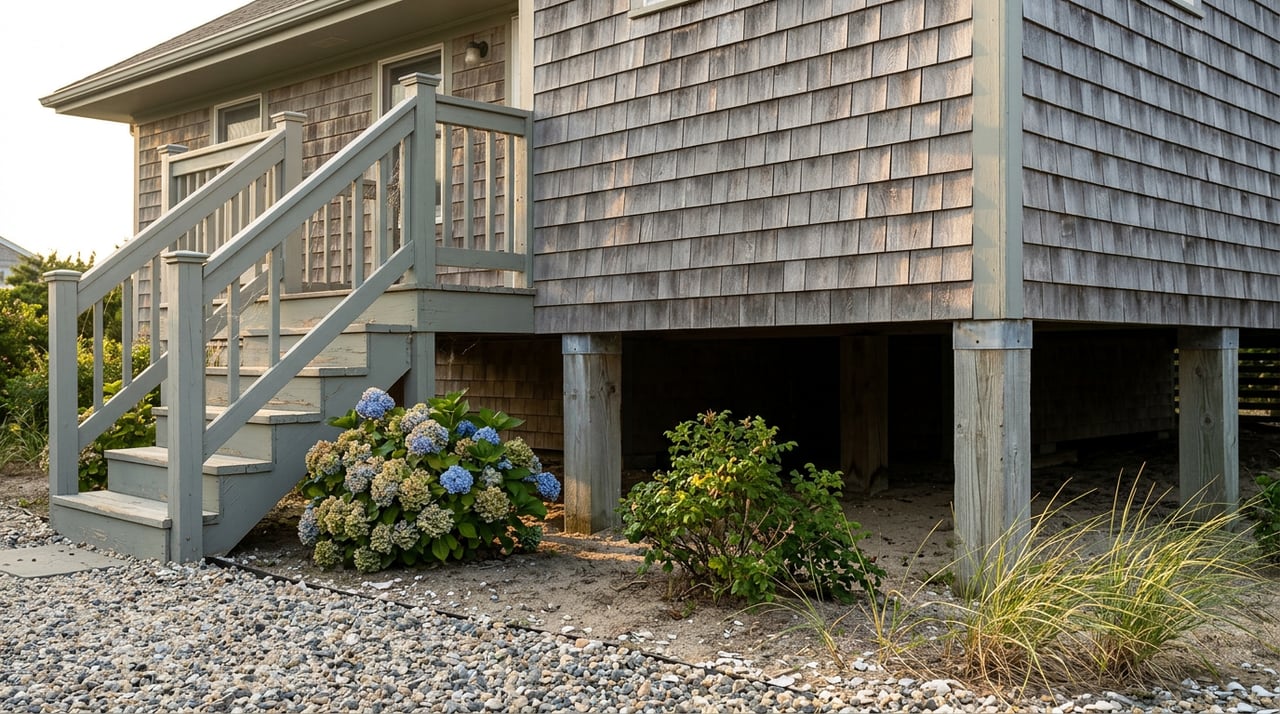
Read that against the numbers above. A buyer who picks up a 1,400-square-foot Mulberry Point cottage at $875 a square foot because the total price looked manageable next to a townwide median of $879,000 may be one kitchen-and-bath renovation away from triggering a full elevation requirement. Piers, columns, or open foundations become mandatory in a VE zone once that 50% threshold is crossed. The entry price is real. The cost of eventually updating the home is a separate conversation the list price never has with you.
The overlooked alternative: in-town water views without wave-zone exposure
For buyers drawn to the water but wary of VE-zone construction rules, Guilford's in-town condo stock offers a middle path. The Residences at 66 High Street, built out in the Chittenden and Leete Buildings a few blocks from the Guilford Green, overlook the salt marsh and Long Island Sound without sitting directly on a wave-exposed shoreline. Buyers get a water view and walkability to town, and any future renovation questions run through the building's association and standard AE-zone rules rather than the VE-zone open-foundation requirements that apply along Sachem's Head or Mulberry Point.
It is not a substitute for direct waterfront living. It is a different set of trade-offs, and one that rarely comes up when the comparison stops at list price.
What this means if you're comparing offers, not just towns
None of this means waterfront is a bad buy. For boating buyers, the calculus includes access that a spreadsheet won't capture, like a slip at the Guilford Yacht Club on the West River, within five minutes of open water and a short run to the Thimble Islands. That kind of access has real value to the right buyer. The point is narrower: the town median is a poor proxy for what any specific Guilford property will actually cost you, on the water or off it.
If you are comparing an in-town colonial to a waterfront cottage, run the price per square foot on both, then ask what flood zone the waterfront property sits in and what a future renovation would trigger. Those two questions will tell you more than any median ever will.
FAQ
Does a Zone VE designation affect what a lender will approve? Flood insurance through the National Flood Insurance Program is required for federally backed mortgages on properties in high-risk zones like VE and AE, and that policy is separate from a standard homeowners policy. Lenders factor the added insurance cost into underwriting, so it's worth getting a flood zone determination early in the process rather than after an offer is accepted.
Is every home in Sachem's Head or Mulberry Point in Zone VE? Not necessarily. Flood zone boundaries are drawn parcel by parcel based on elevation and wave exposure, so two homes on the same street can carry different designations. A property-specific flood map check through Guilford's Engineering Department is the only way to confirm a given address.
What triggers the "substantial improvement" rule in practice? It's based on cost, not scope. If the fair market value of planned work, from a kitchen gut to a full second story, reaches or exceeds 50% of the structure's current value, the entire building must be brought up to current elevation code. A buyer planning any major renovation on a waterfront property should get that valuation math done before making an offer, not after.
Guilford's waterfront market rewards buyers who understand what they're actually pricing. If you're weighing an in-town home against a shoreline property, or trying to figure out what a specific Guilford address is really worth once flood zone and renovation costs are on the table, Claire Kilmer can walk through the comparison with you. Get your free home valuation and start with numbers that reflect your specific property, not a townwide average.